
Meet Mai Dương: Studying the journey of Dissolved Organic Matter and Black Carbon along Vietnam’s river–ocean continuum with the PLUME campaign
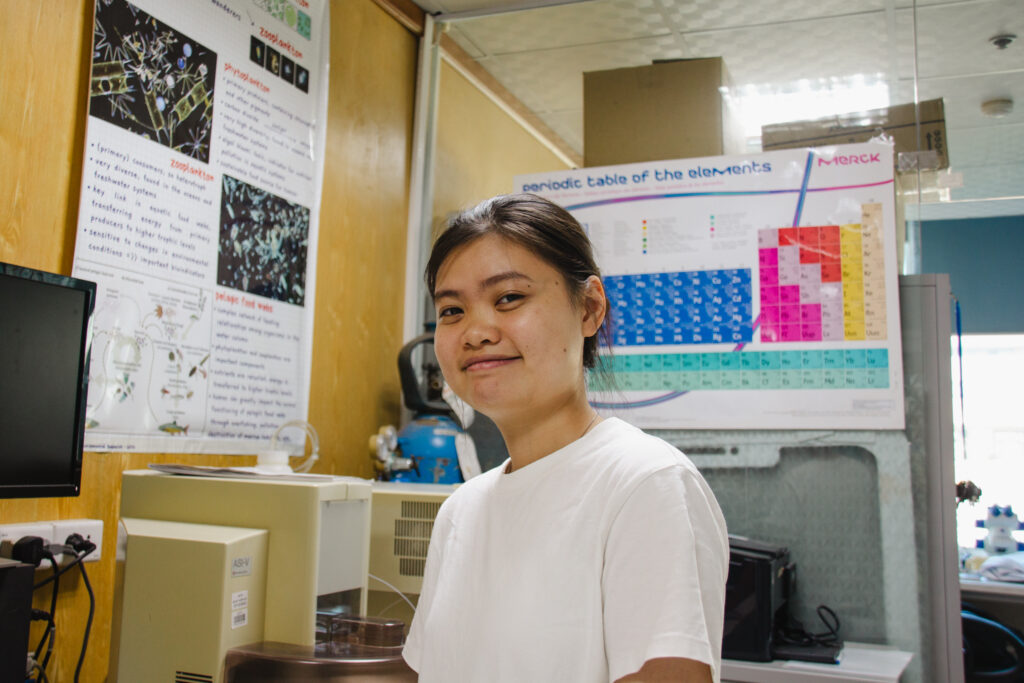
Mai is a PhD student in a joint program between USTH (Vietnam) and AMU-MIO (France), specializing in chemistry. Her journey into research began during her undergraduate years at the Hanoi University of Science and Technology (HUST), where she first explored environmental contamination and later at USTH under the guidance of both French and Vietnamese lecturers. Over time, her fascination with organic pollutants grew, leading her to focus on developing and validating analytical methods to monitor them. Today, her research centers on dissolved organic matter (DOM) and dissolved black carbon (DBC) in coastal waters, studying how these compounds travel from rivers to the ocean, how they transform along the way, and what roles they play in the carbon cycle and water quality.
Understanding DOM and DBC
Mai’s thesis examines DOM and DBC along the Vietnamese coast as part of the international PLUME campaign, which investigates the transport of organic matter from rivers to the ocean.
“DOM is organic material dissolved in water, coming from plants, soil, and human activities,” Mai explains. “A special part of this, called black carbon, is produced when fuels, wood, or biomass burn. It absorbs heat far more efficiently than carbon dioxide and can have strong negative effects on both the environment and human health.”
Because DOM and DBC come from diverse sources and have complex structures, their behavior in aquatic environments is not fully understood. Mai studies how sunlight alters these compounds during their journey, and uses isotopic techniques (δ¹³C) to trace whether the carbon originates from plants, fossil fuels, or human activities. Her work addresses three key questions:
- Determining DBC and DOM concentrations along the river-to-ocean continuum and estimating their fluxes to the ocean.
- Assessing how sunlight transforms DBC and DOM, including changes in composition and contribution to the carbon cycle.
- Analyzing δ¹³C signatures to understand sources and transformations of these compounds in natural waters.
PLUME Campaign and International Collaboration
“By understanding how DOM and DBC move and transform, we can better guide water management and improve climate model predictions.”
Through PLUME, Mai hopes her research will clarify how rivers transport organic matter and black carbon to the ocean, providing data that can strengthen environmental protection and pollution management in Vietnam and Southeast Asia. This work is especially important because the region is a hotspot for anthropogenic black carbon, with rivers and deltas stressed by dense populations, industrial activity, and climate-driven events. PLUME therefore addresses urgent local challenges while generating insights that are essential for global biogeochemical and climate research.
Mai became involved in the PLUME campaign through her PhD project, which provided essential datasets and the opportunity to work closely with international scientists. “Working with IRD researchers from France has been transformative,” she reflects. “I’ve learned new analytical methods, the importance of standardized protocols, and how to communicate scientific ideas across cultures. Beyond lab work, collaborating internationally taught me project management, teamwork, and how to approach research from a global perspective.”
Looking Ahead
The next steps for Mai include finishing sample analysis from the PLUME campaign, completing her experiments, and writing her main research chapters. She will then focus on publishing her first papers and attending international conferences.
“For the months ahead, you can wish me successful experiments, motivation, and energy to finish my thesis,” Mai says with a smile. “And of course, new ideas, fruitful collaborations, and a successful PhD defense in the end.”